Cultivating Talents Through Education
Share to Line Share to Facebook Share to X Print ContentThe 12 principles of green chemistry originated from “The Pollution Prevention Act” of the United States Environmental Protection Agency (U.S. EPA) in the 1990s. The aim of green chemistry is to promote the reduction or elimination of hazardous substances during the use or generation of hazardous chemical substances in the new-generation innovative chemistry technology. The U.S. EPA explicitly stated that green chemistry is centered on removing hazardous substances from chemical processes, as defined by “Green chemistry is the design of chemical products and processes that reduce or eliminate the use or generation of hazardous substances.”
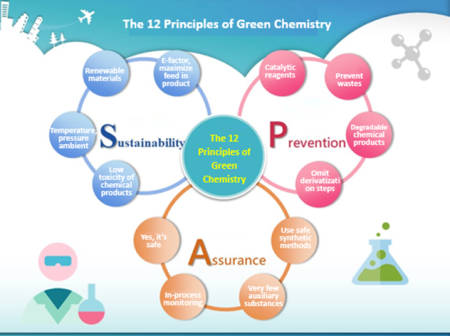
Prior to the start of the 21st century, a group of chemists started promoting the concept of green chemistry. Among them, notable U.S. scholars Paul Anastas and John Warner stood out for their proposition of the renowned Twelve Principles of Green Chemistry in 1998. These principles, which focused on reducing or eliminating chemical pollution at its source, have gained substantial prominence as guidelines for cultivating environmentally friendly products and processes. Their significance within the chemical industry is underscored below:
1.Prevention: It is better to prevent waste than to treat or clean up waste after it has been created.
2.Atom economy: Synthetic methods should be designed to maximize the incorporation of all materials used in the process into the final product.
3.Less hazardous chemical syntheses: Whenever practicable, synthetic methods should be designed to use and generate substances that possess little or no toxicity to human health and the environment.
4.Designing safer chemicals and products: Chemical products should be designed to effect their desired function while minimizing their toxicity.
5.Safer solvents and auxiliaries: The use of auxiliary substances (e.g., solvents, separation agents, etc.) should be made unnecessary wherever possible and innocuous when used.
6.Design for energy efficiency: Energy requirements of chemical processes should be recognized for their environmental and economic impacts and should be minimized. If possible, synthetic methods should be conducted at ambient temperature and pressure.
7.Use of Renewable Feedstocks: A raw material or feedstock should be renewable rather than depleting whenever technically and economically practicable.
8.Reduce derivatives: Unnecessary derivatization (use of blocking groups, protection/ deprotection, temporary modification of physical/chemical processes) should be minimized or avoided if possible, because such steps require additional reagents and can generate waste.
9.Catalysis: Catalytic reagents (as selective as possible) are superior to stoichiometric reagents.
10.Design for degradation: Chemical products should be designed so that at the end of their function they break down into innocuous degradation products and do not persist in the environment.
11.Real-time analysis for pollution prevention: Analytical methodologies need to be further developed to allow for real-time, in-process monitoring and control prior to the formation of hazardous substances.
12.Inherently safer chemistry for accident prevention: Substances and the form of a substance used in a chemical process should be chosen to minimize the potential for chemical accidents, including releases, explosions, and fires.
The promotion of green chemistry by the Chemicals Administration, Ministry of Environment, is based on the ""National Chemical Substance Management Policy Guidelines"" approved by the Executive Yuan. To achieve the vision of ""effectively managing chemical substances and building a healthy, sustainable environment,"" the Administration aims to accomplish ""knowledge building"" by promoting general education courses in higher education institutions and graded teaching materials for elementary schools. Furthermore, it seeks to establish an information exchange for safe chemical alternatives and continuously research international strategies for promoting green chemistry to achieve ""risk reduction"" and enhance ""capacity management.""
The promotion of green chemistry education utilizes diverse teaching materials, progressing from simple to complex concepts. It places a special emphasis on training elementary school seed teachers to firmly root the education at the foundational level, thereby facilitating comprehensive promotion and encouraging public participation.
- Source:
- Ministry of Environment
- Published:
- 2023-08-11
- Updated:
- 2026-10-28
