Taiwan-U.S. jointly defend Asia-Pacific, strengthen governance capacity for emerging pollutants
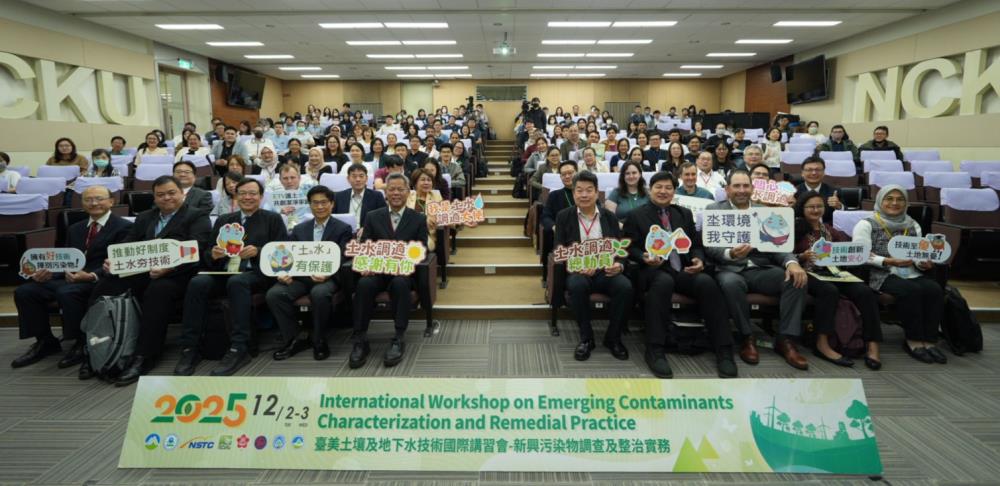
Share to Line Share to Facebook Share to X Print ContentThe Ministry of Environment (MOENV) continues to promote international cooperation on soil and groundwater pollution investigation and remediation technologies, strengthening and sharing capacities for managing emerging contaminants. Its subsidiary Environmental Management Administration (EMA) held the “2025 International Workshop on Emerging Contaminants Characterization and Remedial Practice” on Dec. 2-3, 2025, at the International Conference Hall of National Cheng Kung University. Co-hosted by the MOENV and the U.S. Environmental Protection Agency (USEPA), the event brought together experts from USEPA, the U.S. Geological Survey (USGS), and Belgium, Australia, Japan, South Korea, and other countries to exchange views on analysis methods, background value studies, and remediation technologies for per- and polyfluoroalkyl substances (PFAS), drawing participation from industry, government, and academia at home and abroad.
In his opening remarks, EMA Director-General Yen Hsu-ming noted that soil and groundwater are fundamental to public health, agricultural production, and ecosystems. In recent years, Taiwan has continuously strengthened its capacity for investigating and managing emerging contaminants. PFAS present high complexity in distribution monitoring, data analysis, and governance strategies, making interdisciplinary and international cooperation essential for sharing experience and responding effectively.
Victoria Tran, principal deputy assistant administrator of the Office of International and Tribal Affairs at USEPA, said during her visit to Taiwan in September this year, she was deeply impressed by Taiwan’s proactive role in global environmental governance. She emphasized that the workshop was an important outcome of cooperation under the “International Environmental Partnership Program.” The U.S. continues to advance PFAS management to ensure the public has clean air, land, and water resources, and looks forward to further strengthening governance capacity through exchange and collaboration.
The workshop covered topics including analytical methods and background concentration investigations, and presented the latest remediation technologies and cases such as nanobubble and activated carbon treatment, ex situ adsorption, and soil thermal treatment, helping participants grasp international trends and practical applications.
The EMA noted that Taiwan currently serves as the chair country of the Asia-Pacific Remediation for Soil and Groundwater (ReSAG) working group. To expand the effectiveness of regional environmental governance cooperation, representatives from seven member countries were specially invited to share remediation status and management strategies. International information exchange was used to strengthen regional governance capacity. Going forward, Taiwan will continue to collaborate with the U.S. and Asia-Pacific partners to promote pollution prevention, research and development of green remediation technologies, and experience sharing, thereby enhancing capacity for managing emerging contaminants.
The EMA emphasized that soil and groundwater protection constitute the final line of defense for environmental safety. Taiwan will integrate advanced international technologies and governance experience to continue promoting sustainable and resilient remediation and prevention strategies, working with regional partners to safeguard soil and water resources.



- Source:
- Ministry of Environment
- Published:
- 2025-12-02
- Updated:
- 2026-03-10
